Showing posts with label Week 2. Show all posts

Saturday, August 31, 2019

Feedback Thoughts

"Seven Ways to Crush Your Self Doubt" by John Spencer


To summarize the points illustrated by this article, the seven ways to eliminate self-doubt are: you don't have to be perfect, maintain a growth mindset, and don't compare yourself to others. The article raises some very good points. I agree that one shouldn't compare themselves to someone. Everyone has a different set of skills and circumstances in life, and there are too many variables in life to be the same as another person. I also agreed with the growth mindset advice. Viewing "failures" as learning experiences and actually learning from these experiences would help you learn to quit doubting yourself. However, I didn't agree with some of the points made by the article. I think all people should strive to be perfect, and, related, set very lofty goals. While this can cause you to doubt yourself, if you combine perfectionism with the growth mindset you will grow very rapidly. You have to train your brain to not doubt yourself despite not being perfect yet strive to be perfect. However, I understand that when doing more creative projects one should not strive for perfection as there is no true perfection when being creative/artistic.

"Why It's So Hard to Hear Negative Feedback" by Tim Herrera


The article was written using information from a TED talk named "WorkLife With Adam Grant". The article basically states that people sometimes receive negative feedback poorly because they take negative feedback as a reflection on themselves instead of as a reflection on their work. However, the article suggests that if you can learn to view the negative feedback as advice and teach yourself that you're judged for the improvement attempt as well as the mistake. Training your brain to read the situation this way causes you to try harder to improve.

My Thoughts

As a student, I've used feedback to grow. Even bad grades are a form of feedback, though they may be a little harsh. However, I managed to not succumb to self-doubt and was able to grow through these experiences. The most productive feedback I have ever gotten has been poor quiz grades. Quiz grades don't greatly impact your overall grades. After failing a quiz, I know what I need to improve upon. However, I have also had useless feedback - mainly in English classes here at OU. In English classes, it seems that you lose points but are not told why. Therefore, you cannot attempt to improve yourself because you have no useful feedback.

I chose this image because I like the quote. Those who are scared to fail and learn
can't grow. Image from Professor Gibbs's "Padlet" page on Canvas

Project Topic Brainstorm

Topic 1: Weapons of the Gods

The weapons of the gods is an interesting topic because I can go in many directions with it. I am very interested in history and could retell any of the modern weapons races using stories from Indian mythology. Time periods that quickly come to mind are: World War 1, World War II, and the post World War II weapons race. Some immediate parallels between modern weaponry I noticed were: Pinaka and supersonic planes and missiles, the Teen Baan and bombs, Trishula and nuclear weapons. I will look up the weapons on Wikipedia, and follow some Wikipedia Trails to stories about the weapons. 

Source: Professor Gibbs's List of Weapons of the Gods Readings

A depiction of Trishula on a piece of art from Wikimedia

Topic 2: Vishvakarma

Professor Gibbs told me about Vishvakarma in my introduction post. Vishvakarma is engineer and architect of the universe. He is worshipped by many engineers, architects, and craftsmen. As a civil engineer, engineering and architecture interest me greatly. I appreciate the complexity of modern-day structures such as bridges and buildings. I will likely search for more stories of Vishvakarma to help adapt stories of him. Specifically, I'd like to dive deeper into the City of Gold stories. However, I could already likely write stories about some feats of engineering and architecture and relate these to Vishvakarma.

Source: Wikipedia

Depiction of Vishvakarma from Wikimedia


Topic 3: Rama, Ravana, and Sita

In many of the storybooks I read through, the main plot was Ravana kidnapping Sita and Rama trying to get Sita back. I'm interested in potentially using this topic because I read many good stories using the Ramayana as the adapted plot during the storybooks reading assignment. The stories took the plot from the Ramayana, the first Indian Epic we will be reading in this Indian Epics class. I could write a story paralleling the plot of the Ramayana but simplified into a more modern setting. To accomplish this, I will need to read the Ramayana reading assignments in the upcoming weeks. I've found that Wikipedia is a good source to find more parts and characters within the Ramayana, and I will have the Ramayana readings bookmarked, so I've used Wikipedia as the source.

Source: Wikipedia

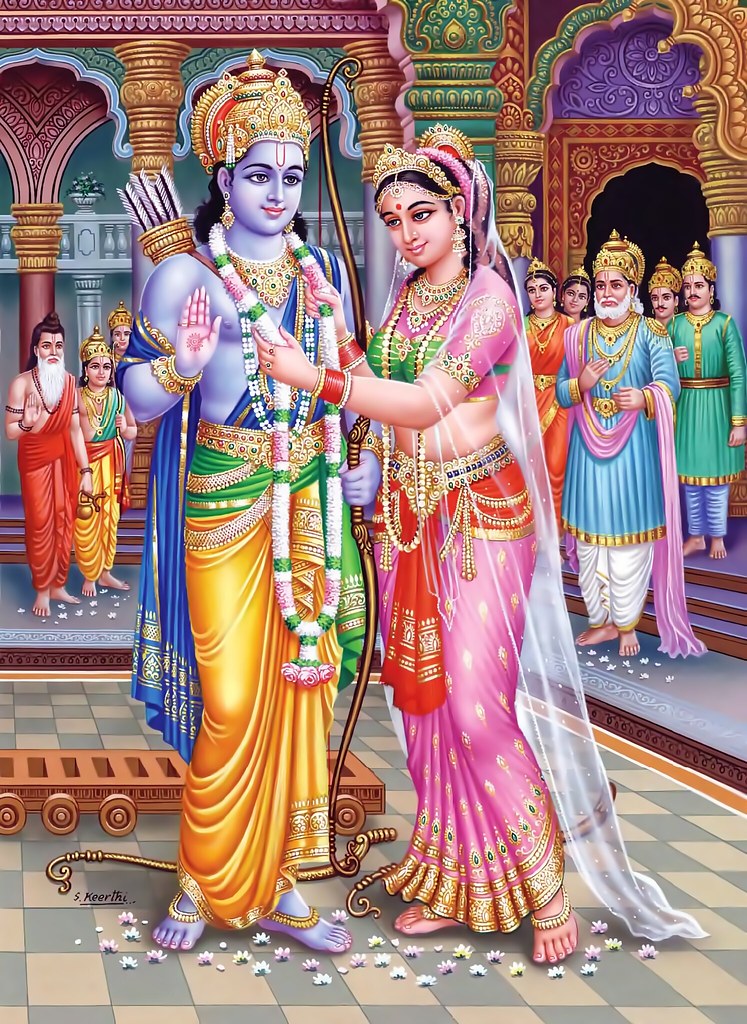
A picture of  Rama and Sita at their wedding from Flickr


Topic 4: Gods/Goddesses

After reading potential project topics from Professor Gibbs's list, I decided that the gods/goddesses offer a lot of story potential. I've decided to include many gods in the stories as it will allow me more room to weave a story, and I am interested in learning more about what each of the gods/goddesses do. If I were to start on the storybook today for the gods/goddesses, I would write a storybook trying to parallel the gods/goddesses to a modern setting such as: the gods as a business group, the gods as college friends, or another topic. Currently, I've read through a Wikipedia article and know that there are gods for about everything in Hinduism. To write stories, I will dive deeper into gods that interest me, such as Brahma, Vishvakarma, and Ganesha.


An image of Ganesha from Flickr

Wednesday, August 28, 2019

Week 2 Story: The Tsunami that Never Was

The Tsunami that Never Was

Jack was a young fisherman who lived on a remote island nation with a population of around 100,000 people that was located within the Pacific Ocean. As you may know, many islands in the Pacific Ocean lie within the Ring of Fire, a notoriously seismically active zone of the world. In fact, the island nation itself was born from origins much like Hawaii - from fiery magma rising through the crust of Earth and slowly building a taller and taller mountain.

The residents of the island were all used to the earthquakes and volcanic eruptions, but all of the locals feared that one day an explosive eruption or massive earthquake would be the demise of the island nation. In fact, there was so much fear that the locals were apt to have nightmares of their island being destroyed.

One day, Jack was alone and fishing off the shore on a remote part of the island when he heard a rumble. Immediately, Jack thought that this rumble must be an earthquake, but he was not too concerned as the rumble did not last long. However, Jack noticed the rumbling emanating from the rocky slopes leading into the ocean again and immediately feared that there may be a larger earthquake than he had experienced before. Jack then noticed a large, 40-feet tall wave approaching the shoreline. Jack was sure that an earthquake had struck and caused an incoming tsunamic. Jack left his fishing gear and tore off back towards the town to notify the island news station.

This image from Pixabay depicts a wave much like the one Jack saw.

Jack entered the news station out of breath and with panic clearly in his eyes. Jack quickly told the station that a tsunami was approaching the island, and everyone needed to evacuate before it arrived. The news station thought Jack surely would not lie about this impending disaster, and they wasted no time and quickly sent out news alerts that a tsunami was on its way to drown the island. As the citizens got the alerts, panic ran high. Residents vigorously pounded on their neighbor's doors trying to alert the others of the impending disaster. The panic quickly spread through most of the nation, and many residents began to abandon their homes and belongings.

Jeff, a geologist on the island, was at his laboratory when the news finally made it to him. He was confused as to why there was panic; his seismographs never detected an earthquake in the past day. To quell the panic, Jeff called the news station and informed them that there had not been any earthquakes, and asked where the story arose from. The news station told Jeff of Jack's story, and that they ran the story because Jack told them there was a 10-feet tall wave at his fishing spot. The news reported that the tsunami was a false alarm, but residents were still panicking.

Jeff had to find out what had happened so that he could ease the fears of the public. Jeff communicated more with the news station, and the news station was able to get hold of Jack. Jack agreed to take Jeff to his fishing spot to show Jeff where the incident occurred.

When Jeff arrived at the fishing spot, he noticed that 1,000 yards down the bank from where Jack was fishing, there was a slope of rocks that had not yet been oxidized by the air - a clear sign that the rock face was fresh. Upon further inspection, Jeff noticed that there were rocks with no algal growth or other organisms; these rocks were very fresh. Jeff had pieced together the story.

Jeff arrived back at the news station and told them that Jack was near the site of a rockslide that displaced enough water to cause a large wave, but that there was no serious danger. The news reported this to the public. Jeff discussed with the news station that they should not report unless they have credible evidence, and the news station learned a valuable lesson.


Authors Note:

This story was based on the Indian mythology story "The Foolish, Timid Rabbit" about a rabbit who thought the world was ending. The rabbit caused hysteria amongst the animals as animal after animal believed that the world was ending, until a brave lion went and confronted the source. When I first read this story, I immediately thought of the current state of news in the United States. False information has spread virally through social media and has even made it from social media into mainstream media. However, I wanted to be more subtle, so I adapted the story to make it easier to read and more entertaining.

Bibliography:

"The Foolish, Timid Rabbit" from Jataka Tales by Ellen C. Babbitt. Online Source

Reading Notes: Jataka Anthology

The Foolish, Timid Rabbit

Source: Jataka Tales by Ellen C. Babbitt
  • A rabbit was asleep under a tree, dreaming about the world coming to an end
    • A coconut falls behind the rabbit, awakening him
    • The rabbit thinks the world is ending and takes off running
  • While the rabbit is running, he tells another rabbit that the world is ending
    • Hundreds of rabbits hear the world is ending, and run by a deer and tell the deer the world is ending
    • Soon an elephant and a fox join in on the running
  • Eventually, the animals come upon a lion
    • The lion did not believe the world was ending and made the rabbit take him back to the source of the story that the world was ending
    • The lion found the coconut, then returned to the rest of the animals to tell them the world was not ending as they had feared

Two Turtle Jatakas 

Source: Jataka Tales by Ellen C. Babbitt
  • The Turtle and the King
    • King's children find turtle by a lake, think it is a demon
    • Children tell the king a demon is at the lake
    • The king's men catch the turtle
    • Children talk of how the turtle will be killed, someone mentions dumping the turtle in a lake with rapids
    • Turtle pretends to think the lake is very cruel and survives happily when the king's men place him in the water
  • The Turtle and the Geese
    • A turtle befriends two geese
    • The geese get ready to migrate, ask turtle to come along
    • Turtle goes along by holding stick in his mouth that geese are carrying
    • Turtle falls to his death when children make fun of the situation and he tries to respond

The Crocodile in the River

Source: Vanarinda Jataka, in The Jataka: Volume 1 translated by Robert Chalmers
  • Another story about Buddha's birth as a monkey king
    • Crocodile also trying to eat the monkey's heart in this story too
  • Crocodile hides by a rock waiting for the monkey to catch him
    • Monkey notices rock is at different elevation
    • Monkey pretends that the rock usually talks to him, crocodile believes him and answers
    • Monkey tells crocodile to open mouth and he would jump in
      • Crocodile listens and closes eyes and opens mouth
      • Monkey jumps on top of crocodile's head and onto bank
      • Crocodile recites a poem about how cunning the monkey is
The image from Wikimedia shows a mugger crocodile, one of India's
three species of crocodile.

The Monkey who Gathered Lotuses

Source: The Jataka Volume 1 translated by Robert Chalmers

  • Buddha birthed as a monkey
    • Had not asked his father and asked his mother why, mother told him that his father is king and kills his sons so they do not take over the tribe
    • Bodhisatta decides to visit father
  • Bodhisatta's father decides to try to kill Bodhisatta by sending him to a lake to pick lotuses, but the lake is haunted by an ogre
    • Bodhisatta notices no animals return from lake and decides to swoop over lake to pick flowers
    • Ogre is so impressed that he carries flowers back to tribe for Bodhisatta
    • The father dies and Bodhisatta is named king of the tribe
  • A poem is recited at the end 

Sunday, August 25, 2019

Week 2 Reading Overview

I have decided to do the public domain edition of the Ramayana. The main contributing factor was the ease of access to the stories, as this edition is free. However, I also like the idea of hearing stories from various authors. Hearing stories from various authors will introduce more writing styles, which I like. I will also get more graphics, which I will enjoy.

The first comic book I read over was titled "Dasharatha: The Story of Rama's Father". I chose this comic book because hunting interests me, both in sports aspects and the effects of hunting as a conservational measure for certain species. After reading through the reading guide, the story really fascinated me. I found it interesting that the Dasharatha was cursed and the curse didn't appear again until the end of the story.

I've chosen to include this image from Professor Gibbs's blog
 as it depicts Dasharatha's sacrifice to get a son, which is mentioned
 in the previous comic. I found this story interesting and wanted
to find a picture to help me better visualize the sacrifice.

The second comic book I read over was titled "Hanuman to the Rescue". I chose this story as I am interested in geology and wanted to find out why and how Hanuman carried a mountain according to Indian mythology. The story ended up being interesting, but not related to geology. However, I would be more interested in learning more about stories like this.

The first video I listened to was titled "Ancient Technology - Atlantas and India". I initially chose this video because I, as an engineer, am very interested in all things technology. Technology constantly changes and is a major factor in many world events. I take a special interest in structural engineering and wartime technologies of ancient civilizations. For example, the Romans had concrete mixes so advanced that the technology was not rediscovered for hundreds of years. The video discussed technologies that the stories in the Indian Epics may be alluding to; these technologies included flight, weaponry, genetic research, and more.

The second video I listened to was titled "Ganga - The Goddess and the River". I chose this video because I am very fascinated by nature, especially waterways. Civilization is always focused around waterways, waterways are hubs for recreation, and waterways create scenic landscapes. Not only that, but waterways have massive amounts of power and shape the land. Water classes are some of the most interesting classes I have taken at OU. The video explains how the Ganga River (better known as the Ganges River) was created according to Indian mythology.